
Clicking play on a brand-new track only to hit a grayed-out screen and a “not available in your region” warning is uniquely infuriating. For the majority of us, firing up Spotify is just second nature. We honestly expect it to work. Yet, treating music as a simple, everyday luxury isn’t a universal reality. In plenty of places, hitting that play button feels less like entertainment and a lot more like a calculated risk. A heavily guarded border crossing, except for digital.
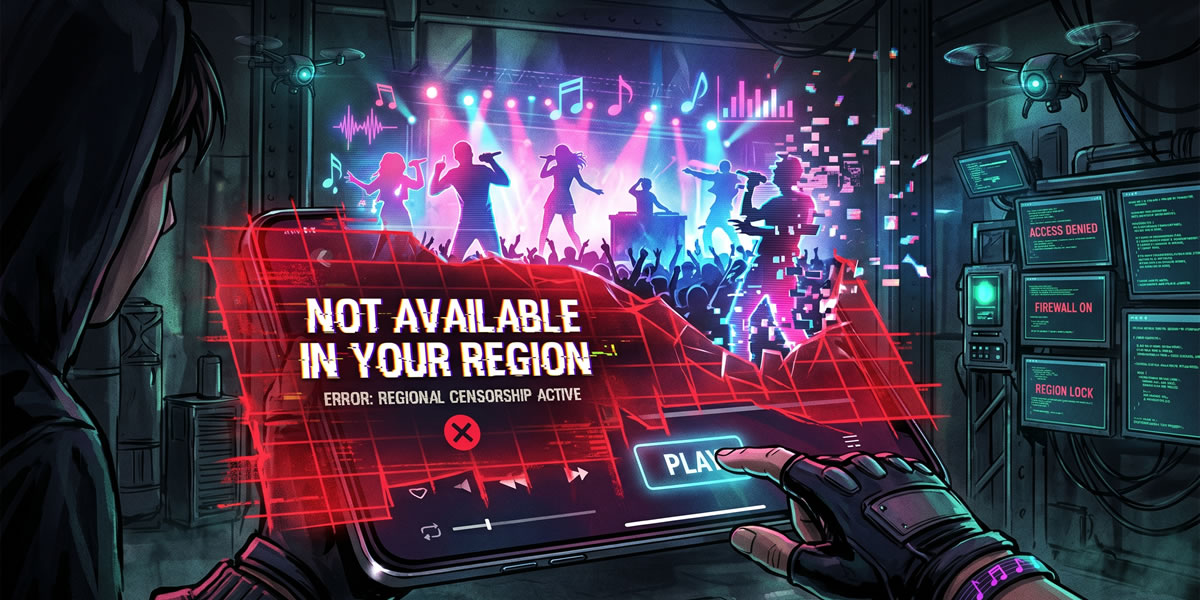
Fandoms, though, operate on a totally different wavelength. Tell a dedicated pop stan they aren’t allowed to listen to an album, and they won’t just log off. They morph into amateur cybersecurity experts overnight. The moment local internet providers pull the plug, fans immediately scatter across forums. The usual move? Digging through obscure tech subreddits to find decent, fast proxy servers site so they can scramble their real IP address. Suddenly, they’ve got this makeshift invisibility cloak. It’s usually just enough to slip right past a national geo-block and get those curated playlists spinning again.
The Artists Deemed “Too Dangerous”
On the surface, mainstream pop seems basically harmless. A killer hook, some heavy synth, maybe a viral TikTok dance trend. What is the actual danger there? Governments, as it turns out, can be remarkably easily spooked.
Just look at Lady Gaga. She had a brief, seemingly polite sit-down with the Dalai Lama way back in 2016. The fallout in China? Instantaneous. Authorities wiped her entire catalog off the map. Millions of local fans woke up to find her music entirely gone. Justin Bieber caught a similar wave of sudden censorship in 2017. Beijing hit him with a ban over past “bad behavior,” meaning his discography practically turned into contraband without warning.
Expanding the Blockade: K-Pop and Beyond
Western stars aren’t the only ones catching heat. The massive K-pop machine constantly runs into intense geopolitical brick walls. Groups like BTS or BLACKPINK generate streaming numbers that most politicians can only dream of. Reach, however, doesn’t equal immunity. Remember the THAAD missile dispute around 2016? China dropped the hammer on South Korean entertainment exports. Poof. Concerts evaporated, and streaming stats from the mainland froze.
Then you have regions like Iran, where the clampdown is far broader. State rules heavily monitor Western pop imports, and solo female vocalists navigate incredibly strict legal boundaries just to be heard. Fans in these areas basically have to fend for themselves in the dark when mainstream apps get blacklisted.

And look, occasionally the bans aren’t even strictly political. Sometimes a track is just a bit too much for local censors to handle. Take the global phenomenon “Despacito.” Malaysia actually pulled the song from state-run broadcasts in 2017. The given reason? Censors judged the lyrics as too suggestive for public consumption.
Digital Smugglers in the Shadows
A few decades back, if you wanted banned music, you had to smuggle bootleg cassettes physically. Real, tangible risk. Today’s rebellion happens mostly behind a keyboard. When a surprise record drops in a restricted zone, listeners don’t waste time complaining on social media. They get organized.
We’re talking massive, synchronized streaming parties hosted deep inside encrypted Telegram chats. People swap highly detailed tutorials on location spoofing. They actively inflate their idols’ streaming stats from the digital shadows, which is honestly fascinating to watch unfold. A track that’s technically illegal in a country can still randomly spike on local charts. Why? Because thousands of teenagers are bouncing their web traffic through overseas servers, keeping the song on a relentless loop.
The Hook Always Survives
Trying to successfully ban a pop song is, quite frankly, a fool’s errand. It’s like trying to catch smoke. Algorithms will definitely get smarter over time. The digital borders are probably going to become much harder to cross. Regulators will keep trying to micromanage exactly what hits our headphones.
But authorities consistently misjudge the sheer, obsessive determination of a fanbase. Throw up a massive firewall, and someone is already figuring out how to build a better digital ladder. Because at the end of the day, no piece of code has ever successfully killed off a really good hook.