A listener can hear an unfamiliar song in a playlist, encounter an artist through a fifteen-second video, watch a fan-recorded festival performance, and explore an entire music catalog within minutes. What is changing isn’t where people find music. It’s what happens next.
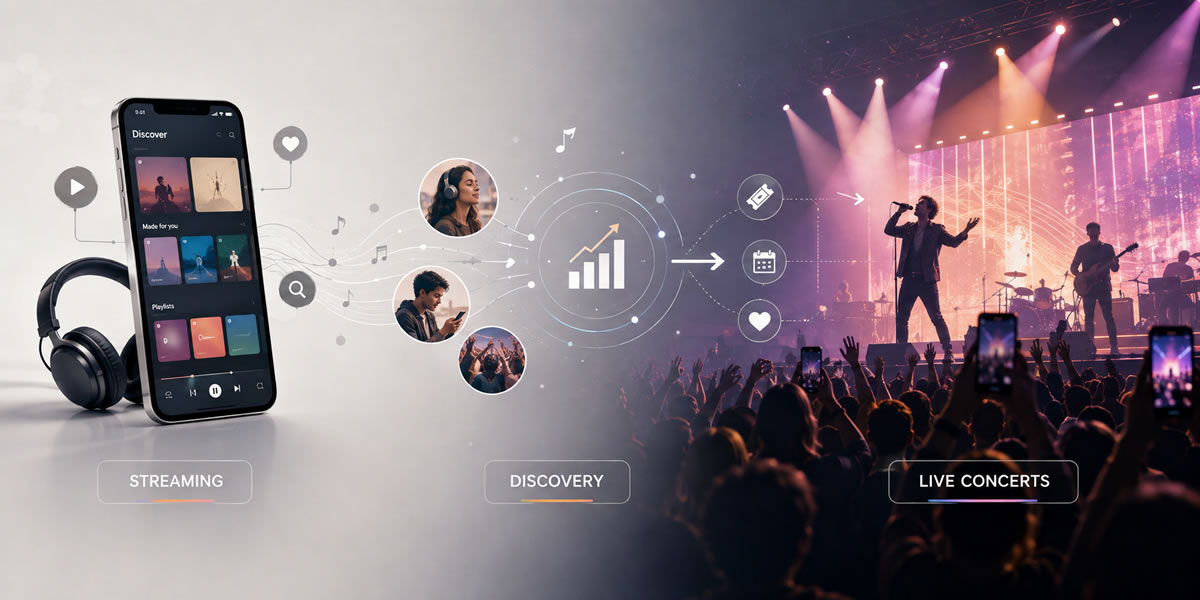
For a growing number of listeners, discovering an artist digitally creates a desire to experience that music physically. A song heard through headphones becomes a concert ticket. A viral performance becomes a festival plan. An artist discovered through an algorithm becomes the reason to travel to another city. The distance between streaming and the stage is getting shorter.
Music Discovery No Longer Follows a Straight Line
Discovering music went through predictable processes for many years. The songs were introduced via radio programmers. Record stores allowed discovering artists and their work. Music magazines reviewed albums. Finally, TV helped discover the performers themselves. All of these ways are not outdated; however, they have been supplemented by millions of digital discovery points.
Recommendations in streams help to discover some artists that the person never even heard about. Short-form videos help to rediscover an old track. A television show might present an old song to a new audience. Music might be discovered through gaming, podcasts, playlists, reaction videos, fandoms, and other sources.
In addition, even the process of discovery is different now. The person does not necessarily discover the song first. It is possible to get interested in the performance before knowing the name of the song. In addition, impressive performances are often shared online, which turns passive observers into music listeners. Thus, live music has also become one of the engines for discovering something new.
Concert Clips Have Become Music Recommendations
Today’s most compelling music recommendations might not seem like music recommendations at all.
They are recordings made within the crowd itself.
- An unexpected artist steps up on stage.
- A crowd performs an entire chorus without their performer.
- A group changes up the arrangement of an otherwise known song.
- A festival crowd responds to the sound of a huge hit.
The recordings spread much farther than that particular venue.
Even though someone in a different city knows next to nothing about the artist, he or she can instantly grasp the atmosphere of the performance.
That creates a powerful thought:
I want to be there next time.
Historically, a concert might have been the reward for already being a dedicated fan. Increasingly, seeing what happens at concerts can be the reason someone becomes a fan in the first place.
Streaming Creates Familiarity. Live Music Creates Memory.
Music streaming has made the consumption of music very friction-free. All the millions of songs are available at the blink of an eye, and one can switch from one artist to another, from one genre to another, from one era to another effortlessly. This is a huge benefit, but at the same time, it makes individual listening experiences disposable.
Concerts are different;
- Specific day.
- Specific venue.
- Specific audience.
- Specific rendition of the concert that would never repeat itself ever again.
This uniqueness lends significance to the live music experience. One can remember the place where one stood when the favorite song began playing. Who went with them? What unexpected songs came up? How did the crowd react? How was the vibe before the encore? The recorded song might have introduced the artist, and the concert becomes the moment associated with that artist.
Setlists Have Become Part of Fan Culture
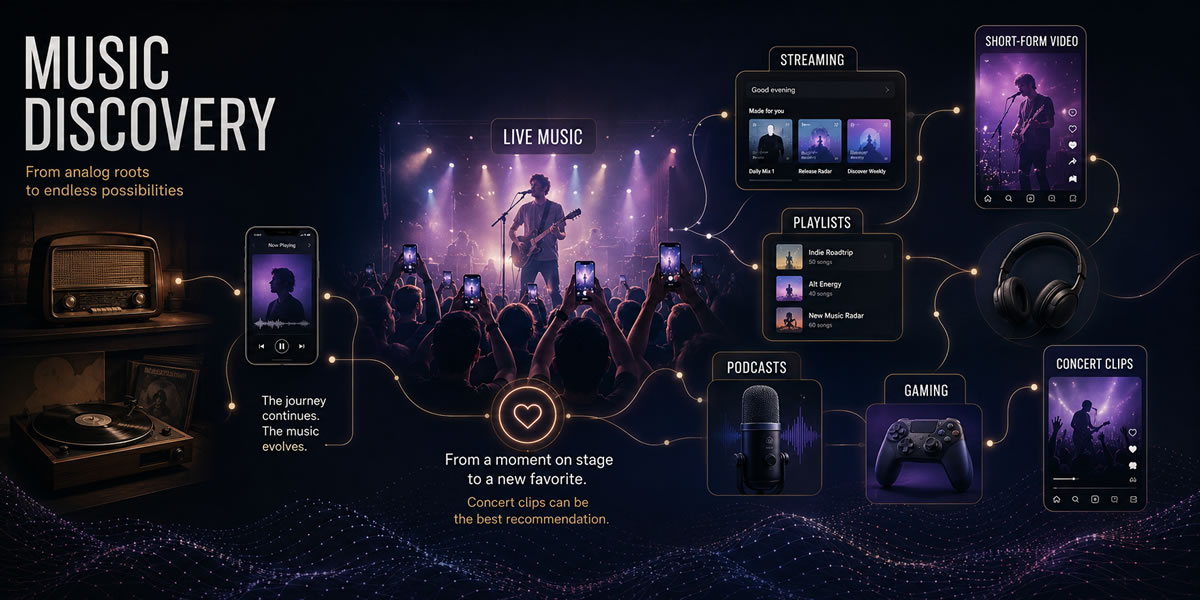
In addition, fans have even more information about the concerts than ever before. Before attending the concert, fans learn what an artist performed in another city the previous day. Fans get to see footage of the stage setup, speculate on potential surprise performances, and monitor modifications in the concert as it goes on tour. Fans have developed a sort of culture around the concert that transcends it. Some fans wish to remain unaware of any spoilers, others analyze the set list, and some even attend different shows hoping to hear a variety of songs.
The large tours even have their own community on the Internet, and each performance turns into yet another episode in an ongoing story. Concerts have become inseparable from the digital culture, which accompanies them long before, during, and after the show itself.
Fans Are Choosing Where to See Artists, Not Just Whether to Go
The change is altering the geography of live music in other ways as well. Rather than waiting for a musician to travel to their city, people now have to ask themselves:
Which tour date should I attend?
Once the information about the dates becomes available through the Internet, fans can instantly compare the cities on the tour. They may find it more exciting to attend a show on a Saturday rather than a Wednesday. Going to a renowned concert hall can add an extra point to the particular date. Playing at a festival allows one to enjoy performances by several favorite artists within just one weekend.
Sometimes, the place of a show becomes another factor. Being able to see a favorite musician when visiting New York, Las Vegas, Nashville, Los Angeles, London, or any other entertainment destination turns a simple performance into a vacation.
The Concert Is Becoming the Center of a Trip
When fans have to go somewhere else to see a performance, going to a concert is about more than just seating. Fans can look at flight options, make hotel arrangements, find transportation options, and find places to hang out around those places. Fans could come a day before the concert. Fans would like to know where to eat close to the venue. Fans would like to know something to do the next morning.
That shift has also created tools that treat live music as the starting point for a broader trip. Platforms such as VewTopia bring concerts, festivals, destinations, stays, and other trip-planning elements together, reflecting how closely live entertainment and travel are becoming connected. The significance isn’t simply convenience. It reflects a different way of thinking about concerts. The event may be the reason for traveling, but it doesn’t have to be the entire experience.
Festivals Accelerate the Discovery Cycle
Music festivals demonstrate this relationship better than almost anything else. People frequently purchase festival tickets because of a handful of artists they already know. Then discovery begins again. A performance on a nearby stage catches their attention. Friends recommend an artist. A gap in the schedule creates an opportunity to see someone unfamiliar. By the end of the weekend, an artist who wasn’t part of the original plan may become a highlight. That discovery continues after the festival.
- The listener follows the artist.
- Songs enter playlists.
- Future releases appear in recommendation feeds.
When the artist announces a headline tour, that former festival discovery may become the next ticket purchase.
The path looks something like this:
digital discovery → live performance → deeper fandom → another live experience
But it can just as easily begin at the festival itself:
live discovery → streaming → fandom → concert
There is no longer one starting point.
Music and Travel Are Becoming More Connected
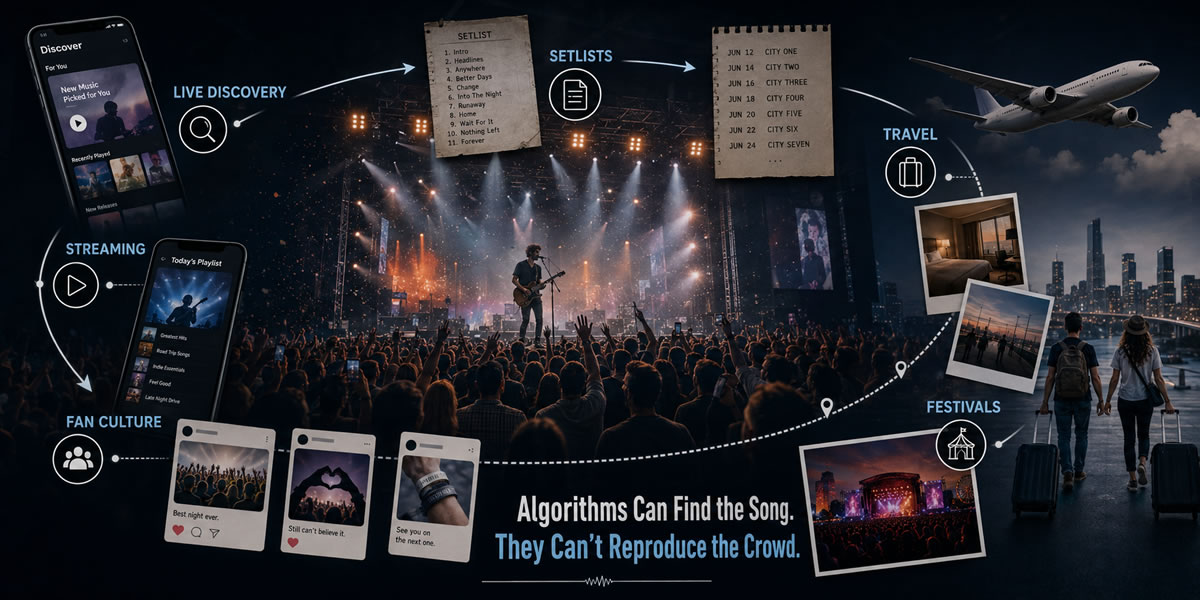
Artists always could inspire travel, yet digital fans have the advantage of being able to remain connected no matter the distance. There is no need for an individual to be from the same area as an artist to stay informed of all their releases and attend concerts.
Place is less important in terms of discovery, yet place becomes very important once a listener decides that he or she wants to experience live music. In this way, we have an interesting flip. Digital technology eliminates any distance between the artist and listener. Live music adds new significance to the distance.
Algorithms Can Find the Song. They Can’t Reproduce the Crowd.
Recommendation technology is going to keep improving. Streaming services will be getting better at anticipating what people will like. Social media platforms will discover songs that are starting to become popular. Custom news feeds will introduce audiences to music they would never hear otherwise.
These methods are very effective at introducing music. However, discovery alone does not make music worthwhile.
- A recommendation algorithm can place a song in front of someone.
- It cannot recreate thousands of people recognizing the opening notes together.
- It cannot reproduce the atmosphere of walking toward a venue.
- It cannot replicate the anticipation before the lights go down.
- And it cannot completely capture what it feels like when a song that has existed privately through headphones suddenly becomes something shared with an entire crowd.
That difference explains why live music remains powerful even as digital listening becomes increasingly sophisticated.
Pressing Play Is Becoming the Beginning
The relationship between digital music and live music isn’t a competition. One feeds the other.
- A song discovered through streaming can create a concertgoer.
- A concert video can create a new listener.
- A festival can introduce an artist.
The music of that particular artist can spark off a journey for another trip a few months down the line. Every encounter sends people into a repeat of the same cycle. Music discovery is thus taking on a whole new meaning and dimension, which is more about the discovery of something way beyond just something to listen to. Streaming might be the place where the love affair starts. The stage, however, is often the place where the memories are made.