
Have you ever stood in the middle of a massive stadium crowd, waiting for the venue to go pitch black, and wondered how they actually pull it all off? For most of us, the process is pretty simple. We buy the tickets, grab an overpriced drink, and find our seats. But the sheer scale of a modern global music tour is honestly baffling when you really look at it.
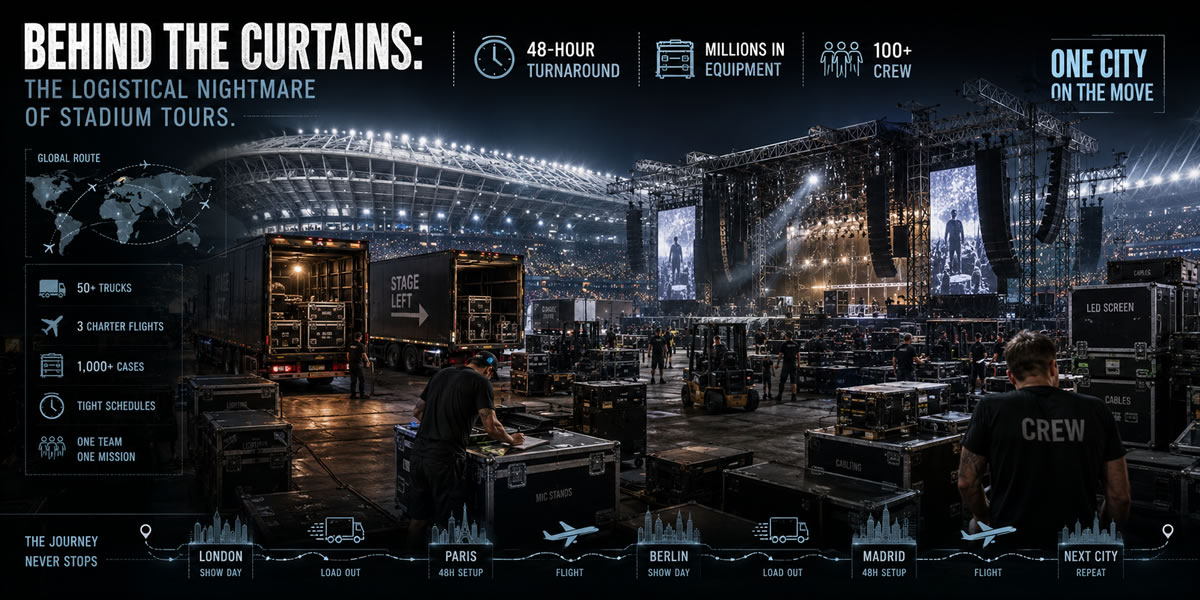
It is essentially a traveling city. Instead of just showing up with a couple of guitars in a beat-up van as indie bands did back in the day, today’s arena tours are moving millions of dollars in custom LED screens, massive audio rigs, and a highly exhausted crew of fifty to a hundred people across international borders every 48 hours. From the outside looking in, it looks like pure, unadulterated rockstar glamour. You see the polished Instagram posts and the beautiful confetti drops. But behind the curtain? It is an exhausting, meticulously planned military operation where every single minute is accounted for.
Pacing the Travel with the Setlist
The biggest headache for any tour manager isn’t dealing with a diva lead singer or a broken drum kit; it is simply getting the talent from point A to point B without anyone having a nervous breakdown. Time is literally bleeding money when you are on the road. You absolutely cannot rely on commercial airline schedules when your frontman has a radio interview in London at noon and a mandatory soundcheck in Berlin by 4 PM.
But here is the reality check: record labels aren’t just handing out endless blank checks for transportation anymore. Modern touring margins can actually be brutally tight. To balance the necessary speed and privacy with the financial reality of the tour’s budget, smart booking agents frequently hunt down private jet empty legs to move the artist and the core management team. Basically, they are just hitching a ride on a heavily discounted charter aircraft that was already scheduled to fly back to its home base empty anyway. It saves tens of thousands of dollars a week, bypasses the absolute nightmare of public airport terminals, and keeps the illusion of infinite wealth completely intact for the fans.
And frankly, the artists desperately need that saved travel time because the physical toll of a modern two-hour setlist is punishing. Fans today expect absolute perfection. If a singer is going to close out the night sprinting down a massive catwalk while belting out an adrenaline-fueled anthem like Blinding Lights, or pouring their absolute soul into a vocal-shredding emotional powerhouse like Rolling in the Deep, they cannot be suffering from middle-seat jet lag.
The pacing of the travel directly impacts the quality of the music. Some of these legacy acts and modern pop stars are performing for nearly three hours a night under heavy stage lighting. You simply can’t roll out of a cramped sleeper bus, quickly stretch your back, and deliver the kind of legendary vocal performance that people paid hundreds of dollars to witness. The travel has to be seamless, mostly so the artist can sleep, hydrate, and physically recover in the air before doing it all over again in a completely new time zone.
The Ground Crew and the House of Cards
While the singer might be catching some much-needed sleep at 40,000 feet, the rest of the logistical machine is grinding away on the ground. Think about the physical staging for a second. For massive stadium runs, there are often two or even three identical stages leapfrogging each other across a continent.
While the band is actively playing the heavy, opening chords of Welcome to the Jungle in Paris, the massive steel stage for tomorrow night’s show in Amsterdam is already being constructed by local union crews. It requires fleets of semi-trucks, complex customs paperwork, and a level of scheduling precision that would probably make a seasoned air traffic controller sweat. And if just one truck gets a flat tire in the middle of the night? Or a border agent decides to hold up the cargo for a random, unannounced inspection? The entire million-dollar house of cards wobbles, and the tour manager is the one left to fix it before the gates open.
Final Thoughts
It kind of changes the way you look at a live show, doesn’t it? We tend to romanticize the road, picturing endless parties and spontaneous acoustic jams in hotel lobbies. The reality is far more rigid, driven by complex spreadsheets, flight trackers, and endless cups of terrible backstage coffee.
The next time you are singing along to your favorite track, surrounded by thousands of screaming fans, take a brief second to appreciate the absolute chaos happening just behind the speakers. That seamless magic we experience in the crowd is only possible because a very stressed-out crew is sitting in a makeshift production office somewhere in the bowels of the stadium, doing everything in their power to keep the show on the road.